

This is one of four Precedent case studies — the adoption and growth story. For the system-level view, see Law Firm AI Ecosystem; for the AI-review interaction model, see Human-in-the-Loop AI Review; for the editor’s process story, see AI Document Authoring.
Context & Team
Demand Composer had proven its core value — 75% of law firm demand letters were authored in it within months of launch — but every new firm still onboarded the expensive way: a customer success manager running live, one-hour training sessions, three or sometimes four per firm. The product that automated demand letters had entirely manual onboarding.
I owned this project end to end: strategy, the business case for tooling, the design of every intervention, and the measurement plan that judged them. I worked with our CSM team— whose calendars were the problem — engineering on Userflow integration, and marketing on the email sequence. As with Demand Composer itself, I didn’t wait for this to be assigned: I advocated for the budget to license Userflow, a digital adoption platform (DAP), and built the plan that justified the spend.

The Problem
Two gaps made onboarding hard, and I named them in Nielsen Norman’s terms because that’s what they were:
Match between system and the real world. Lawyers arrive with a deep mental model of demand letters — and no mental model of AI-assisted authoring software. The distance between “I’m writing a demand for my client” and “I’m managing documents, extraction pipelines, and LLM narratives” is exactly the gap onboarding had to bridge.
Error prevention — fear of the final commit. In a domain where the output is staked on six-figure settlements, new users hesitated at every irreversible-feeling action. Onboarding couldn’t just teach features; it had to build the confidence to press send.
And operationally: human-powered onboarding doesn’t scale. Every CSM hour spent re-teaching the same five tasks was an hour not spent on retention — and the support inbox showed the same questions arriving again and again after the sessions ended.
Process
Heuristics as strategy, not checklist
Rather than brainstorm features, I mapped each onboarding intervention to the usability heuristic it served — which meant each one carried its own success metric from day one:
| Heuristic | Intervention | Target metric |
|---|---|---|
| Help and documentation | In-app how-to guide library | Reduce emails to customer success managers |
| Recognition over recall | Getting-started checklists | Increase engagement with product features |
| Flexibility and efficiency of use | DAP-guided workflows | Shorter “time on desk” per demand |
| Consistency and standards | Welcome email sequence | Replace live training sessions |
The interventions
Resource Center. A persistent, collapsible in-app hub — the single front door to onboarding. It houses the getting-started checklist with a live progress bar, the how-to guide library, “What’s new in Composer,” a contact channel, and a product-market-fit survey.
Getting-started checklist. Five tasks chosen to walk a new user through the product’s actual value path, not its feature list: edit an exhibit, review a case’s strengths, manage medical treatments, update imaging findings, compose an AI narrative. Completing the checklist means you’ve experienced the human-in-the-loop workflow once, end to end.
How-to guide library. Dozens of searchable guides covering the highest-ticket-volume tasks — creating demands, sending for AI processing, editing demand details, uploading exhibits, managing medical treatments — written so support could deflect to them and CSMs could link them instead of scheduling calls.
Welcome email sequence. A five-part educational drip (“1 of 5: Perfecting your exhibits in Demand Composer”…) designed for the inbox lawyers actually live in — built to Outlook rendering constraints, each with one unambiguous next action deep-linking back into the product. The sequence was designed to replace a full hour of live training.
PMF instrument. Inside the Resource Center, the Sean Ellis product-market-fit question — “How would you feel if you could no longer use Composer?” — turning onboarding real estate into a continuous signal of product love.
Measurement built in from the start
Because every intervention had a pre-declared metric, I could evaluate them like experiments rather than launches: independent-samples t-tests comparing firms with and without each intervention, and a chi-square test for the PMF distribution. The results — including the ones that didn’t go my way — are below.



Flows

Key Decisions & Pivot Points
Buying, not building, the guidance layer. I advocated for licensing Userflow rather than asking engineering to build checklists, tooltips, and surveys from scratch — trading budget for speed and freeing engineering for the product itself. Pitching that spend, with the measurement plan as justification, was the project’s first deliverable.
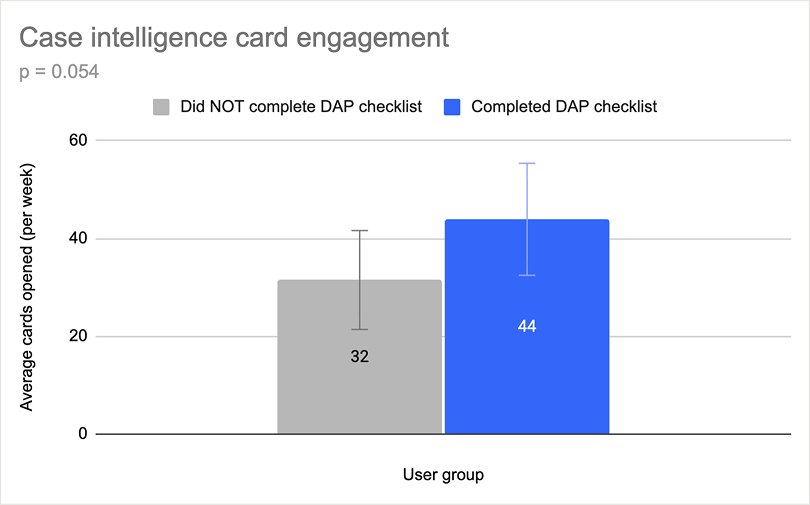
Reporting the null results. Three of my five hypotheses failed to reach significance — and I presented them that way to leadership, p-values and all. Checklists didn’t significantly move feature engagement (p = 0.054). The DAP alone didn’t significantly shorten time on desk (p = 0.059). The PMF distribution didn’t significantly shift (p = 0.053). All three hovered just above the threshold — directional, promising, and honestly not proven. The alternative — rounding p = 0.054 down to a success story — would have corrupted every future measurement the team ran.
Below: release notes and the expanded Resource Center — the one-stop shop for in-app guidance.


Outcomes
What worked, with the statistics:
- How-to guides significantly reduced onboarding support emails. Independent-samples t-test: t(24) = 2.064, p = 0.049 — firms with the guide library generated measurably fewer emails to customer success during onboarding than firms without it.
- The email sequence replaced a one-hour live training session, removing roughly 24 hours of meetings per month from the customer success managers’ onboarding workload — recurring capacity handed back to the team every month.
What didn’t reach significance — reported honestly:
- Checklists → case intelligence engagement: t(20) = 1.17, p = 0.054 — directional, not significant.
- DAP → time on desk: t(42) = 2.01, p = 0.059 — directional, not significant.
- PMF shift: χ²(44), p = 0.053 — not significant.
Context the project operated in: Composer held a 68% product-market-fit score (“very disappointed” without it) and reached $5M ARR in under two years — onboarding’s job was to protect and extend that trajectory as new firms arrived.
What I’d Do Differently
The honest reading of three p-values between 0.049 and 0.059 is that the studies were underpowered — sample sizes in the twenties and forties can’t reliably detect the effect sizes onboarding interventions produce. Given another pass, I’d pool cohorts across quarters before judging, and pre-register the minimum detectable effect so “not significant” and “no effect” stop being confusable. I’d also instrument time-on-desk at the task level rather than the demand level — the DAP likely helps specific steps, and a whole-demand metric averages that signal away.