Overview

Bodily injury demand letters are the backbone of personal injury litigation. They synthesize months or years of medical treatment into a persuasive narrative that communicates a client’s injuries, suffering, and financial losses to insurance companies. Before AI, producing these letters was a brutal process.

Law Firm Status Quo

  • Paralegals manually reading hundreds of pages of medical records, often across dozens of providers
  • Extracting treatments, diagnoses, and billing data by hand into spreadsheets or templates
  • Attorneys spending hours writing narratives that synthesize medical, financial, and personal impact information
  • High error rates; missed treatments, duplicate charges, and overlooked pre-existing conditions slipping through
  • Turnaround times measured in weeks, delaying settlements and straining client relationships

The opportunity was clear: AI could dramatically accelerate this workflow. But the challenge wasn’t just automation,  it was building the right level of human oversight into an AI-powered pipeline so that attorneys could trust the output, catch edge cases, and maintain the professional judgment their clients depend on.

My Role

As a UX Engineer and Product Designer, I owned the design and front-end implementation of core workflows. My responsibilities spanned:
  • Product strategy: Defining the customer journey from document upload through demand letter delivery, identifying where human review adds the most value and where automation should run uninterrupted
  • Interaction design: Designing review workflows for flagged treatments, narrative generation, and context management,  interfaces where attorneys interact directly with AI output
  • Front-end development: Building custom UI components for filterable data tables, inline narrative review, and instruction-based rewriting, bridging design intent with production code
  • Cross-functional leadership: Collaborating with ML engineers on RAG pipeline outputs, aligning product decisions with legal domain experts, and shaping the roadmap around user research findings

Design Approach: Trust Through Transparency

The central design challenge was this: how do you give legal professionals enough control to trust AI-generated content, without making the review process so burdensome that it erases the efficiency gains?

I framed the product around three principles:

1. Surface the Right Decisions, Not All the Data

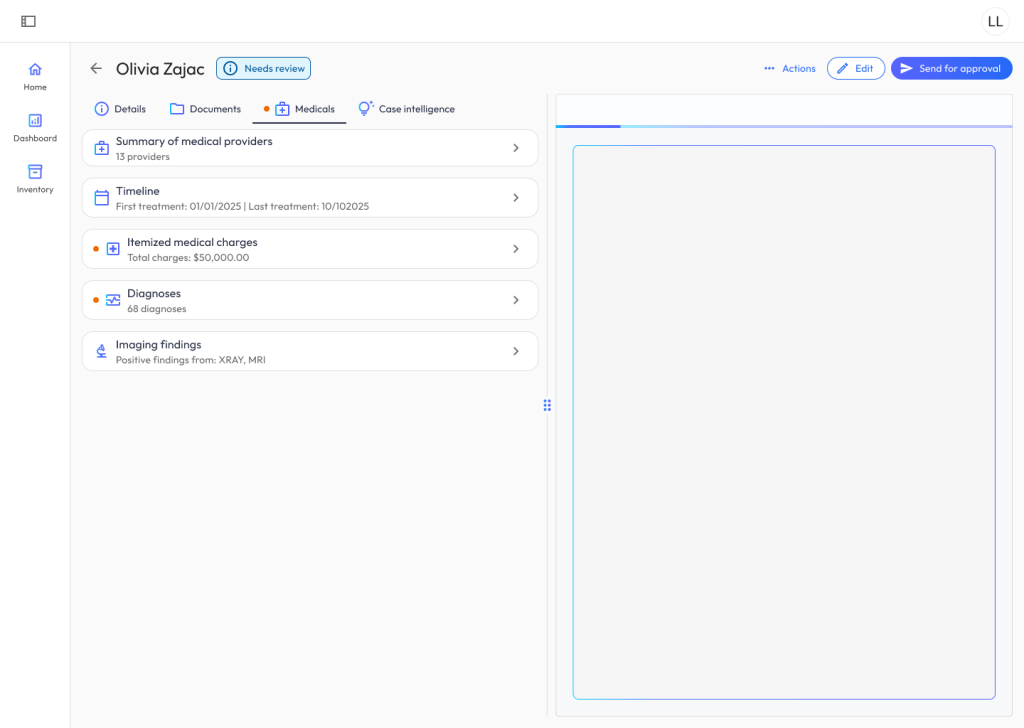
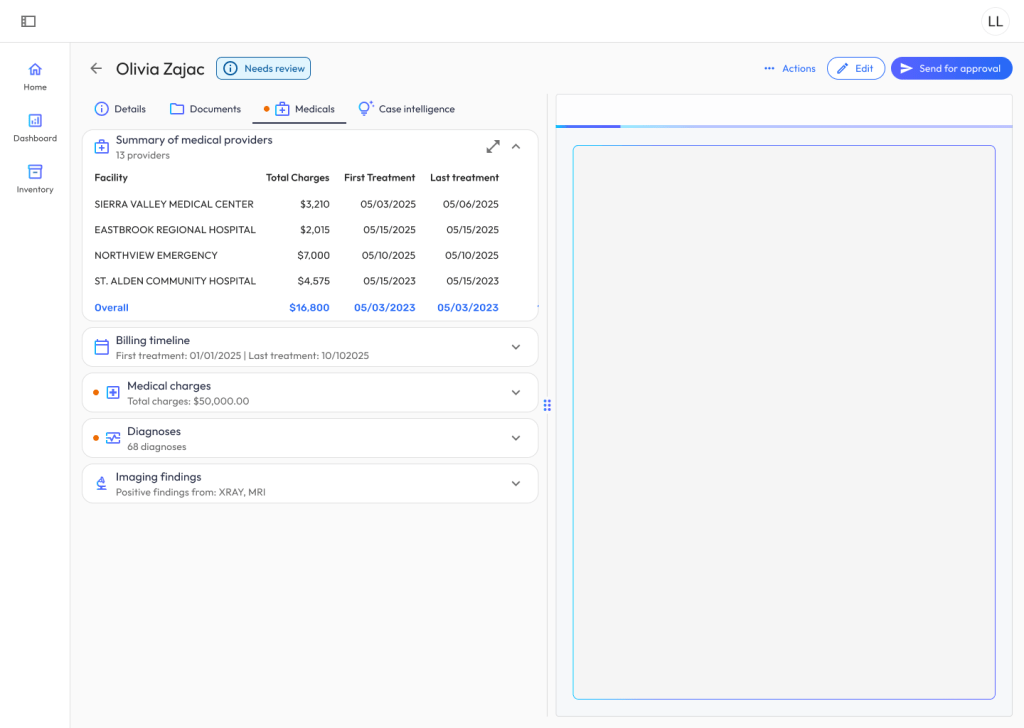
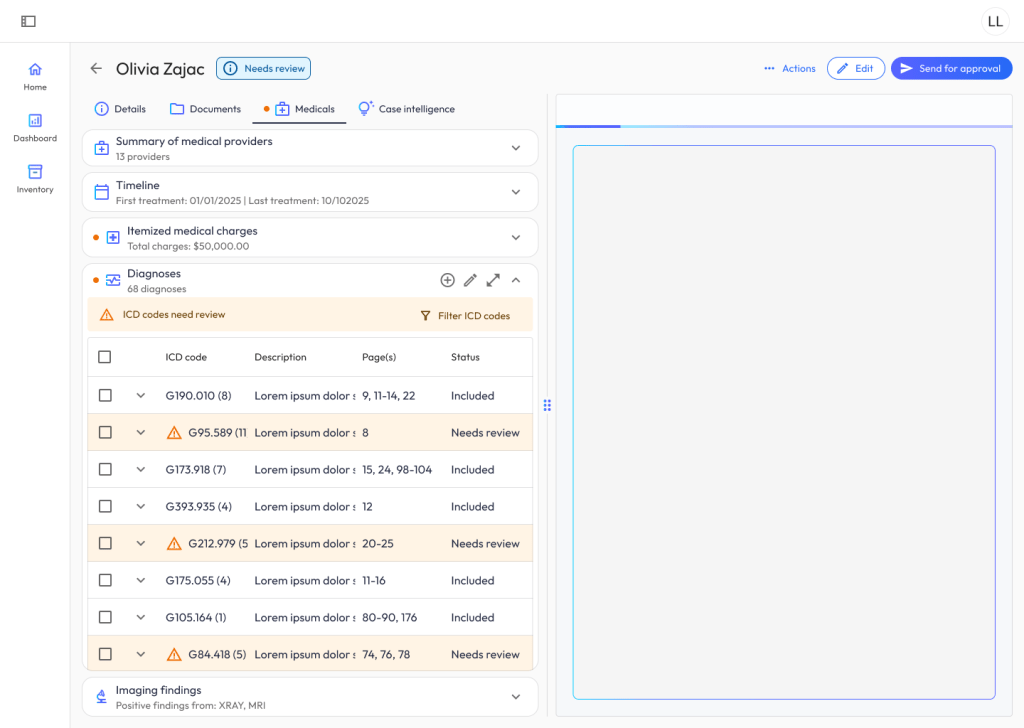
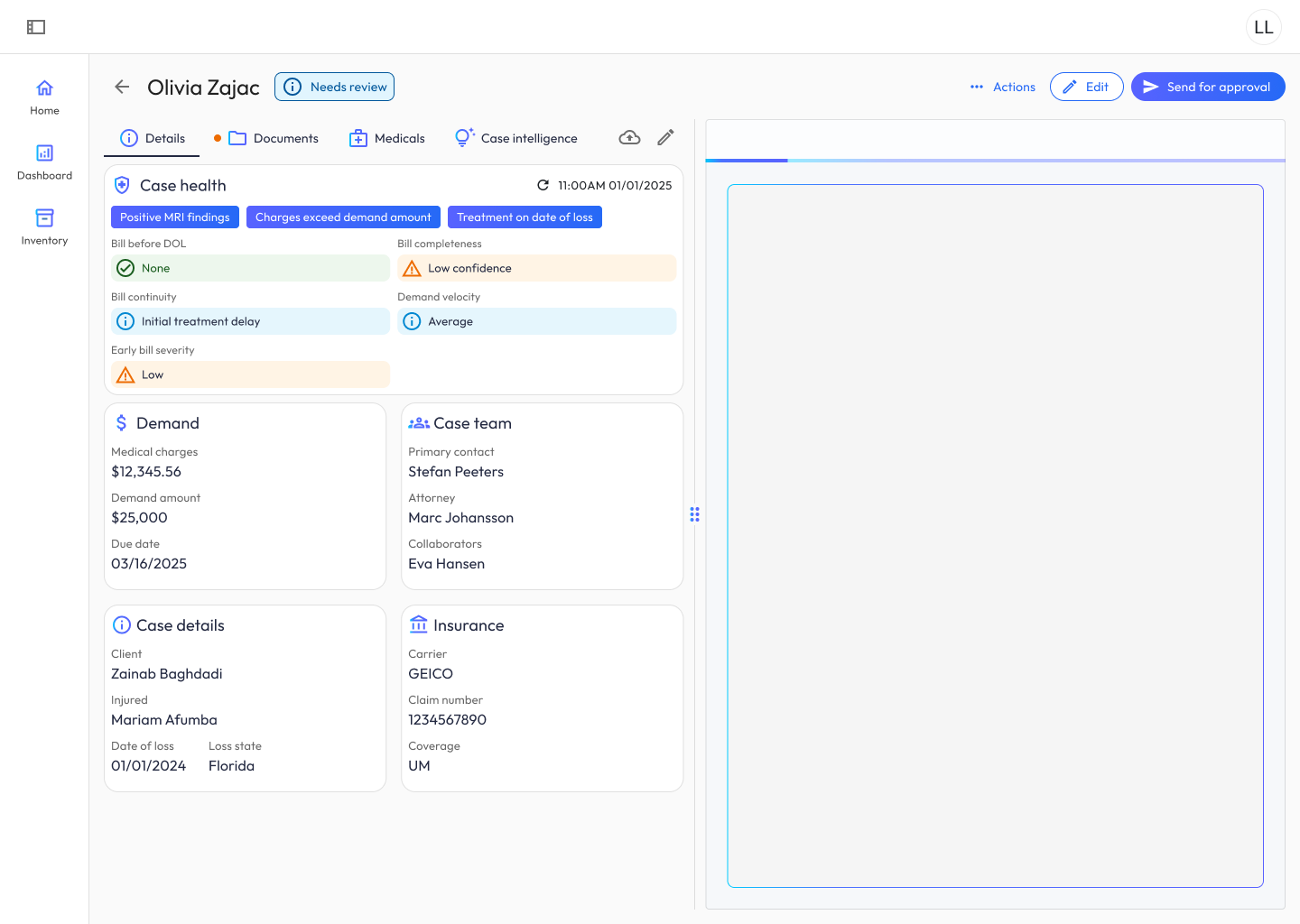
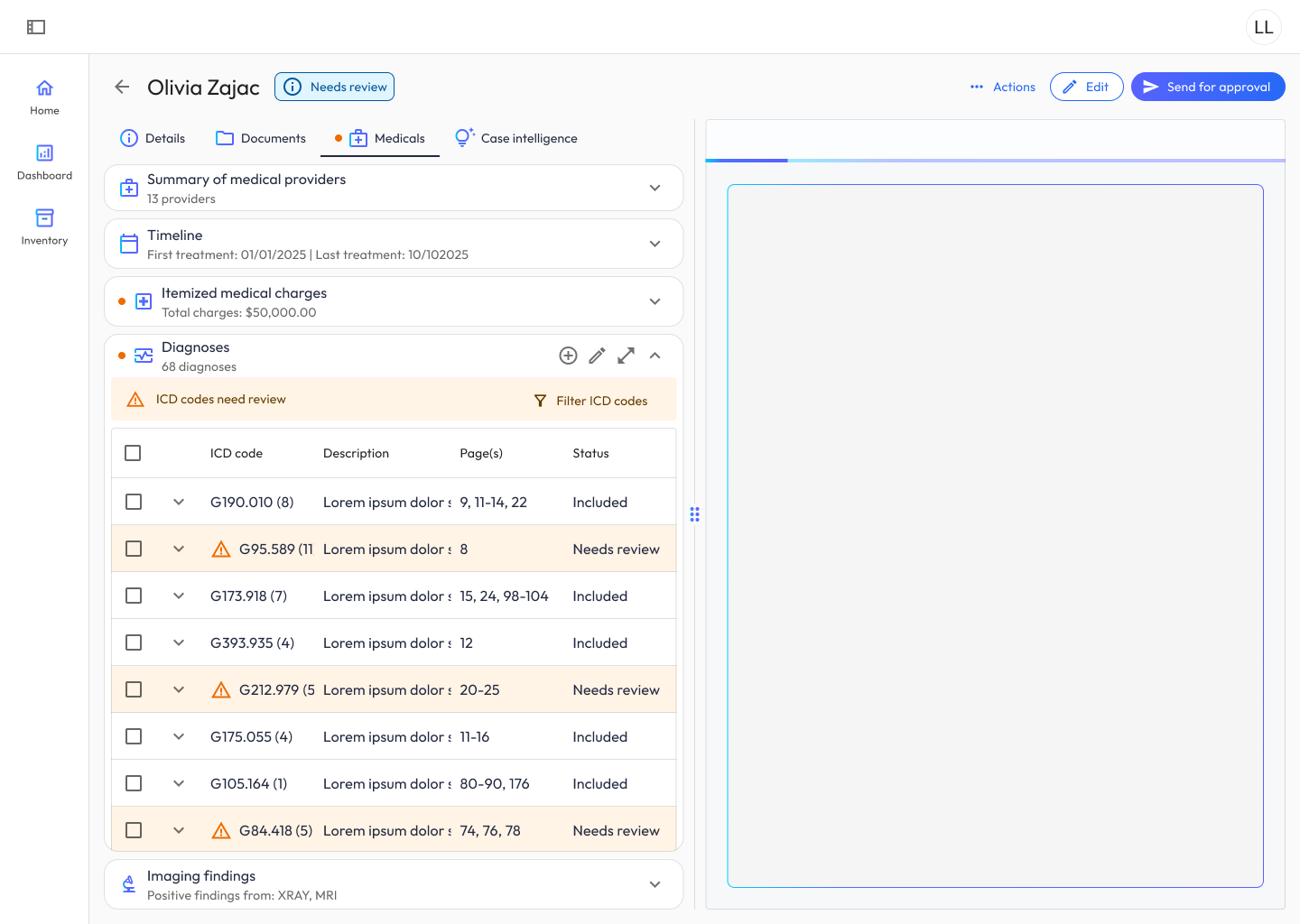
The ETL pipeline processes enormous volumes of medical records. Rather than exposing every extracted data point for review, I designed the system to surface only the items that require human judgment, flagged treatments that the AI identified as potentially problematic.

This meant designing a triage-first experience: the system does the heavy lifting of extraction and organization, and the attorney’s attention is directed to the decisions only they can make.

2. Make AI Output Reviewable, Not Just Readable

There’s a meaningful difference between presenting a wall of generated text and designing an interface that supports active review. I focused on making AI output decomposable, breaking narratives into discrete, reviewable sections tied to specific evidence, so attorneys could evaluate claims against source material rather than reading prose on faith.

3. Keep the Human in Command

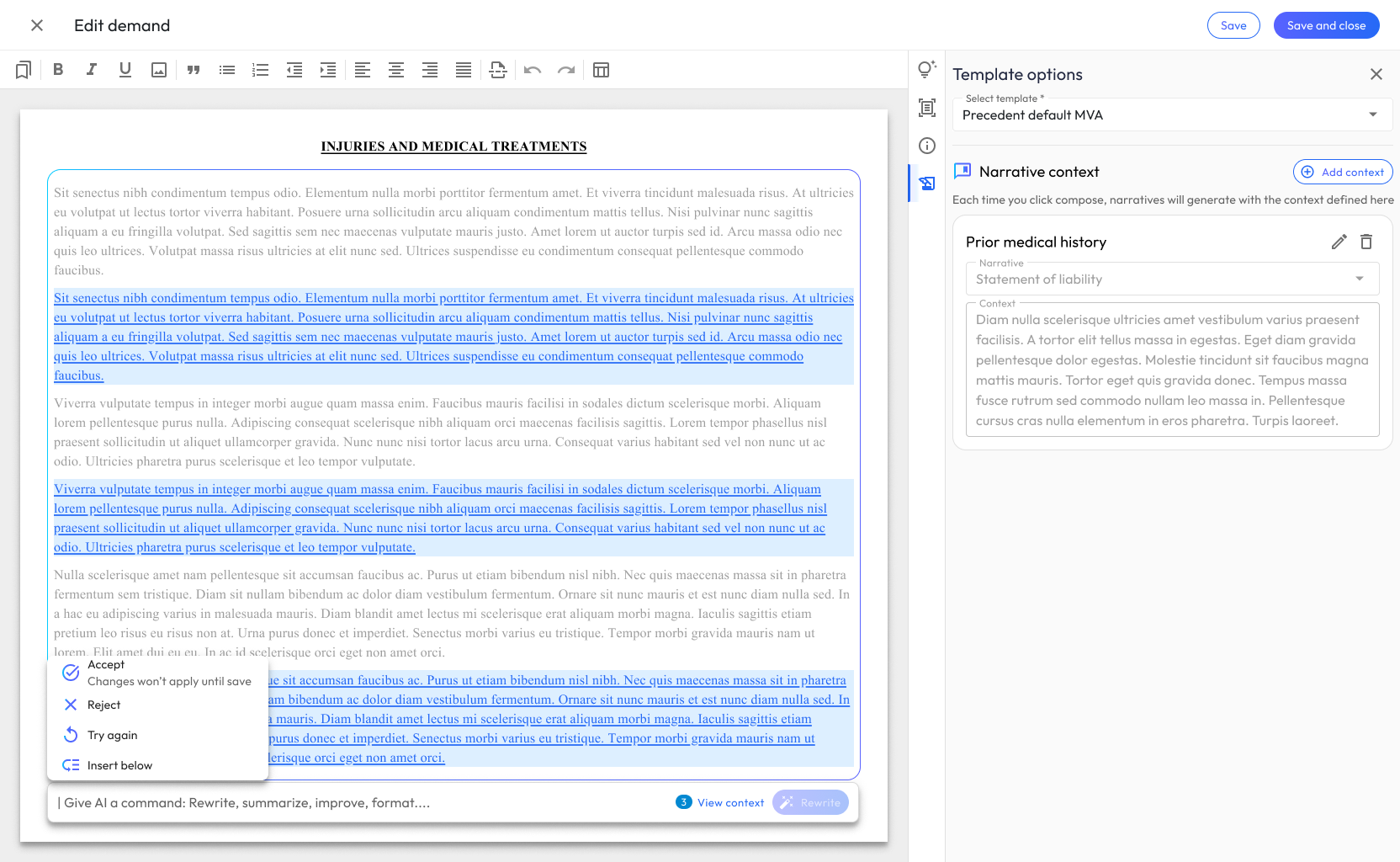
Every AI-generated output is a draft, not a deliverable. The workflows I designed ensure that attorneys can accept, reject, edit, or regenerate any piece of content with custom instructions. The AI proposes; the human disposes.

The Workflow

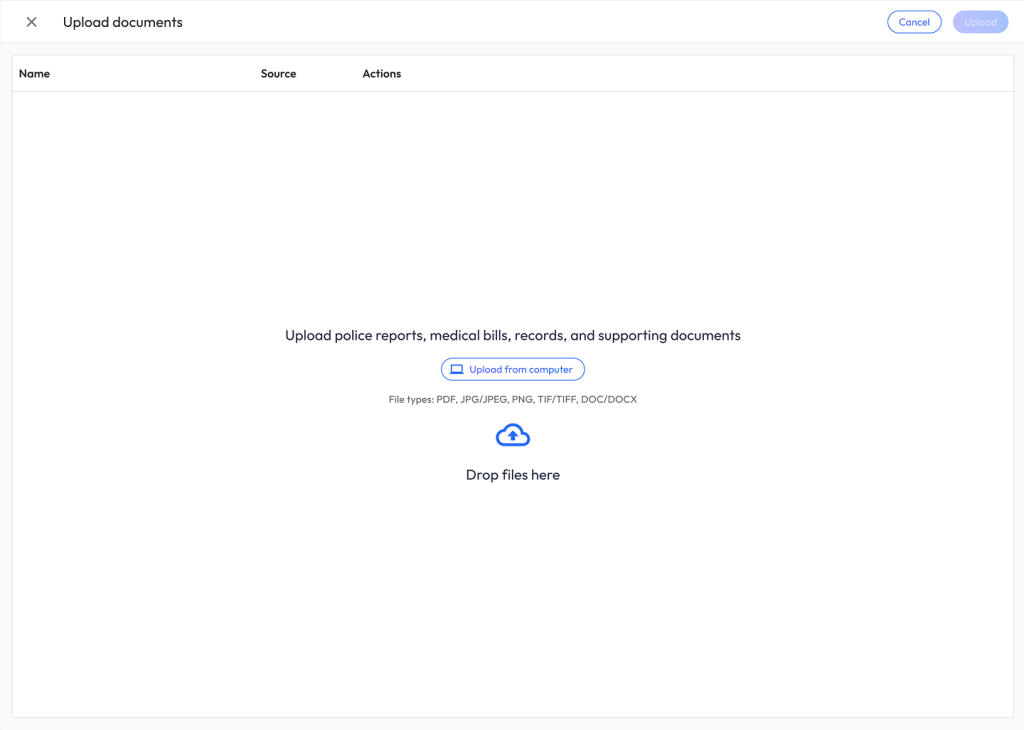
Step 1: Document Upload & Processing

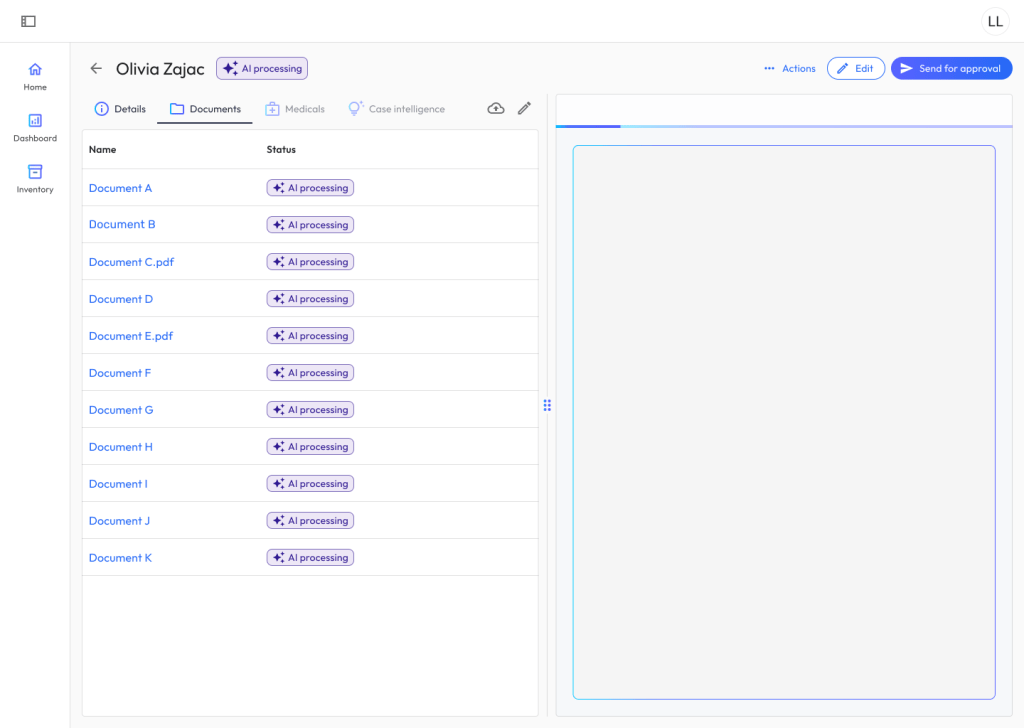
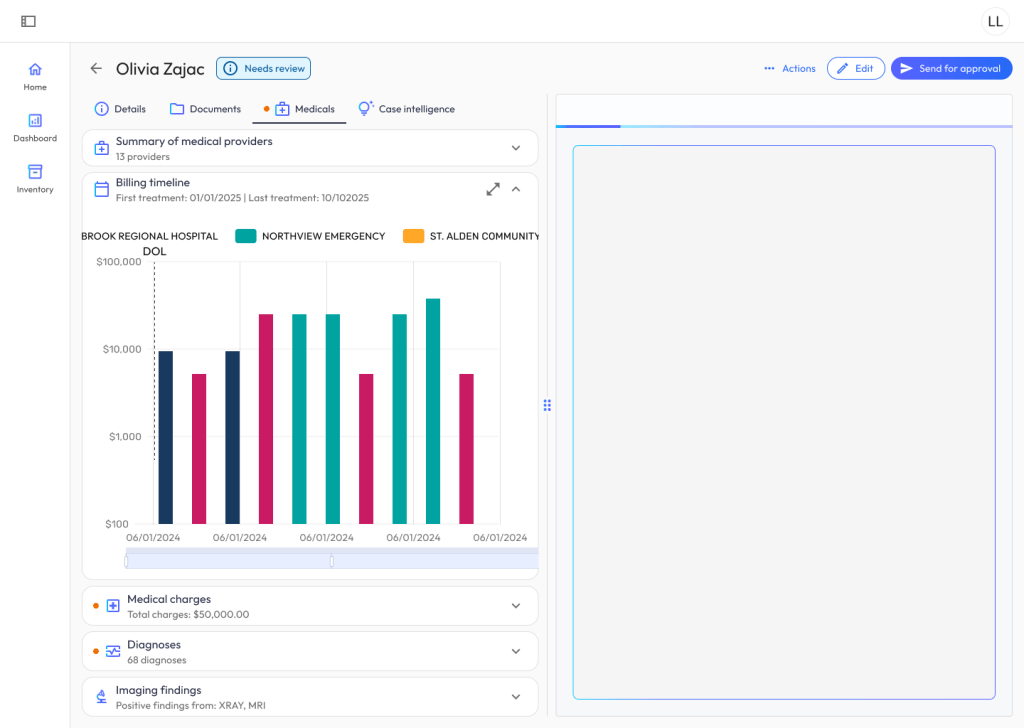
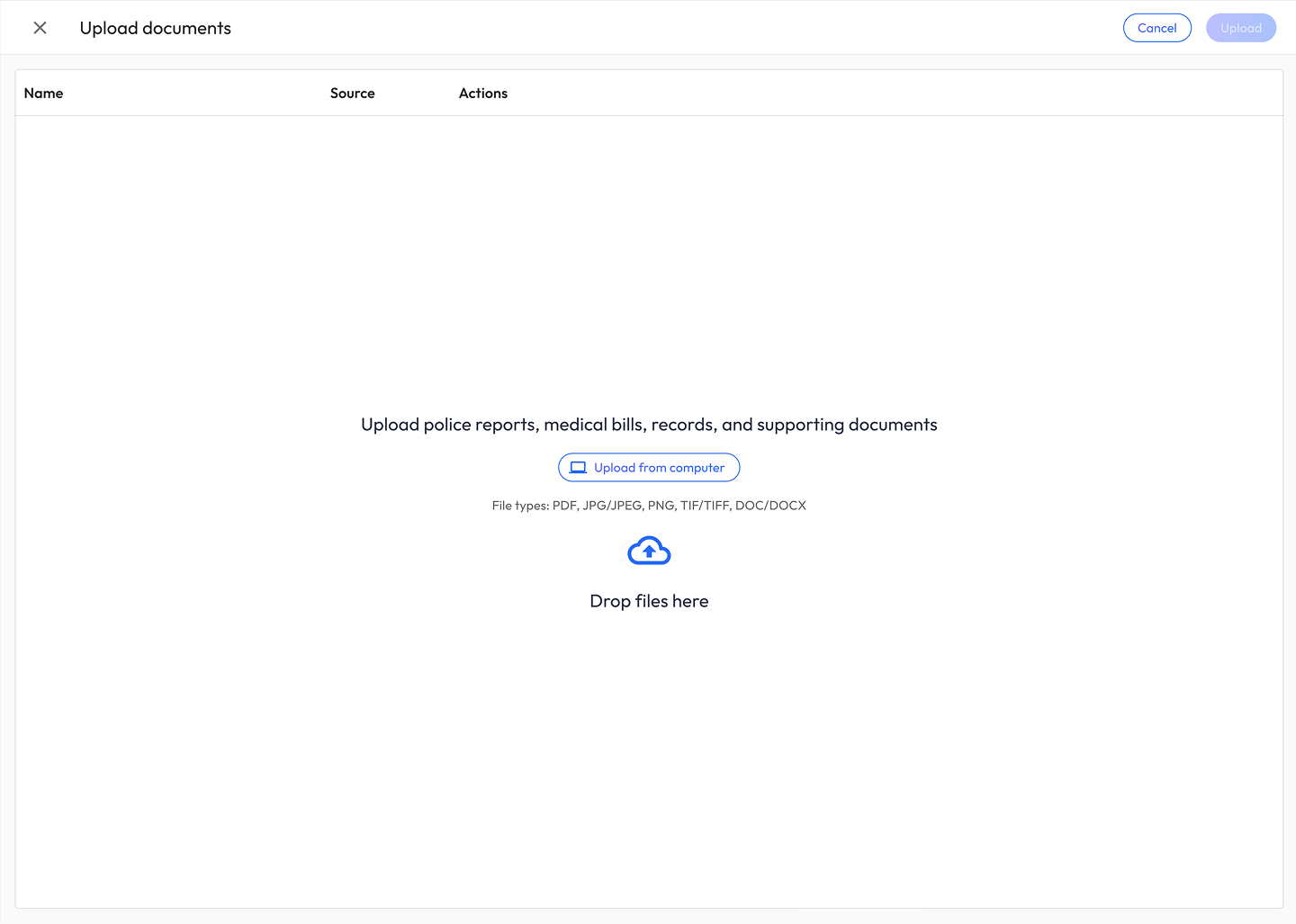
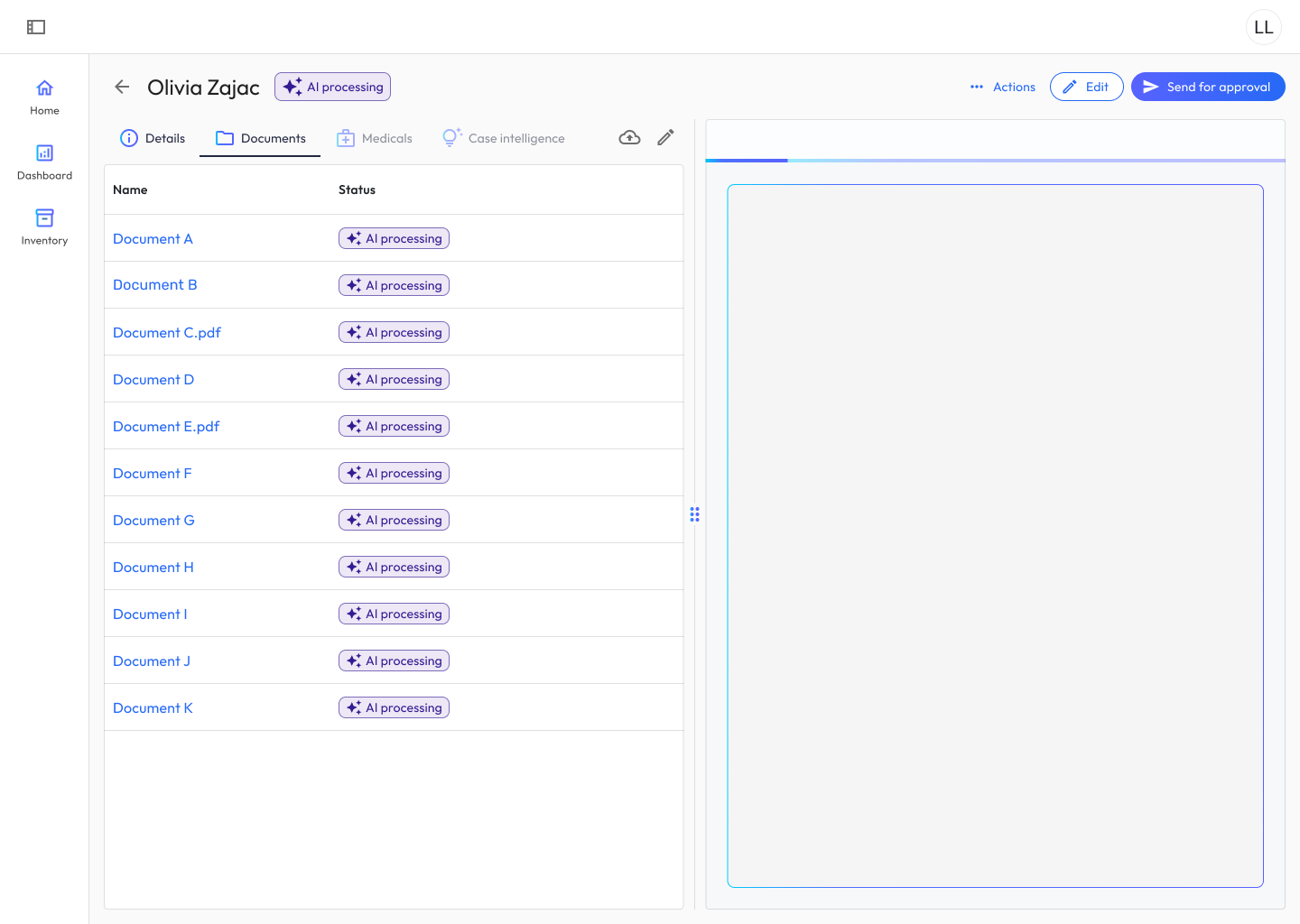
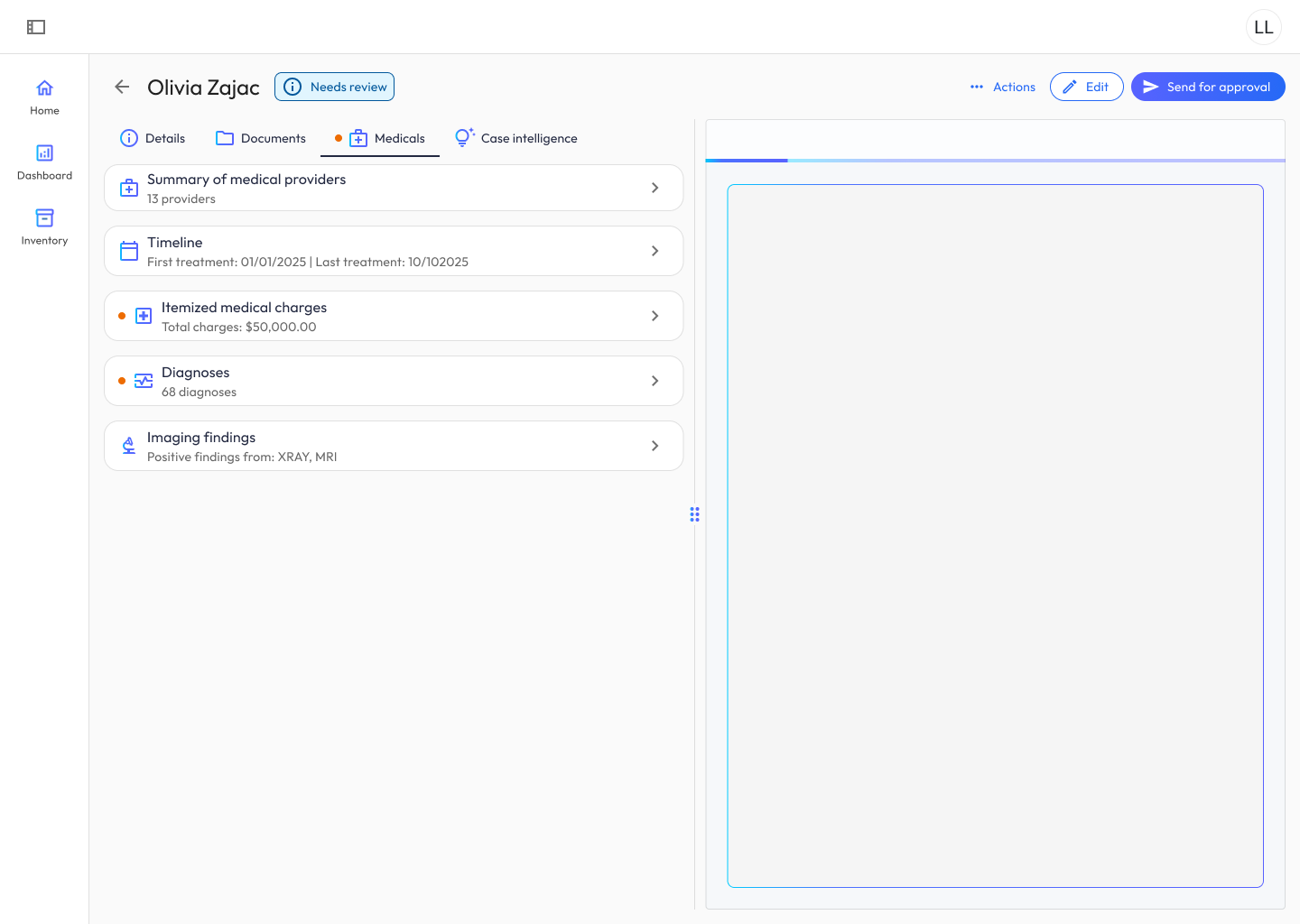
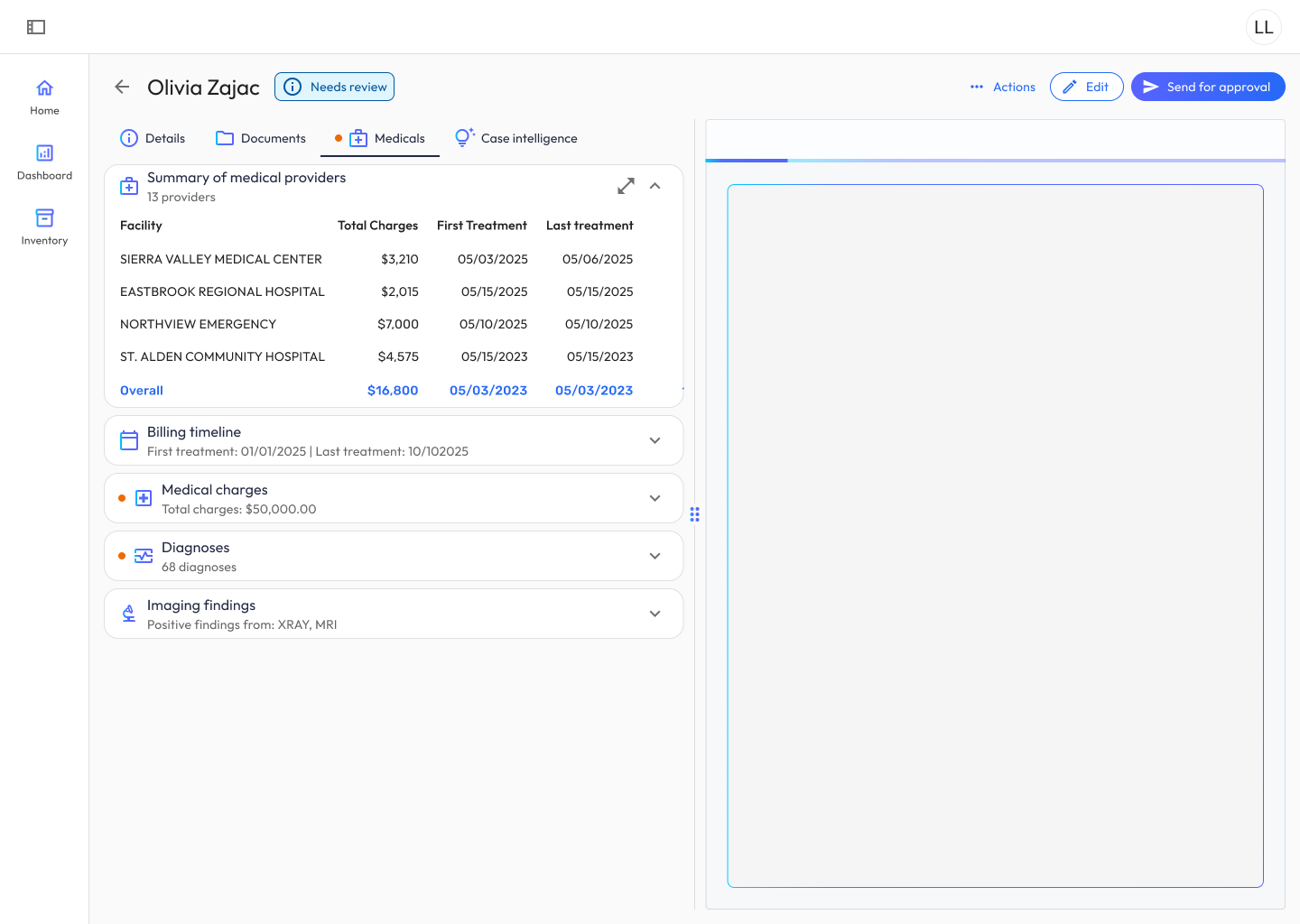
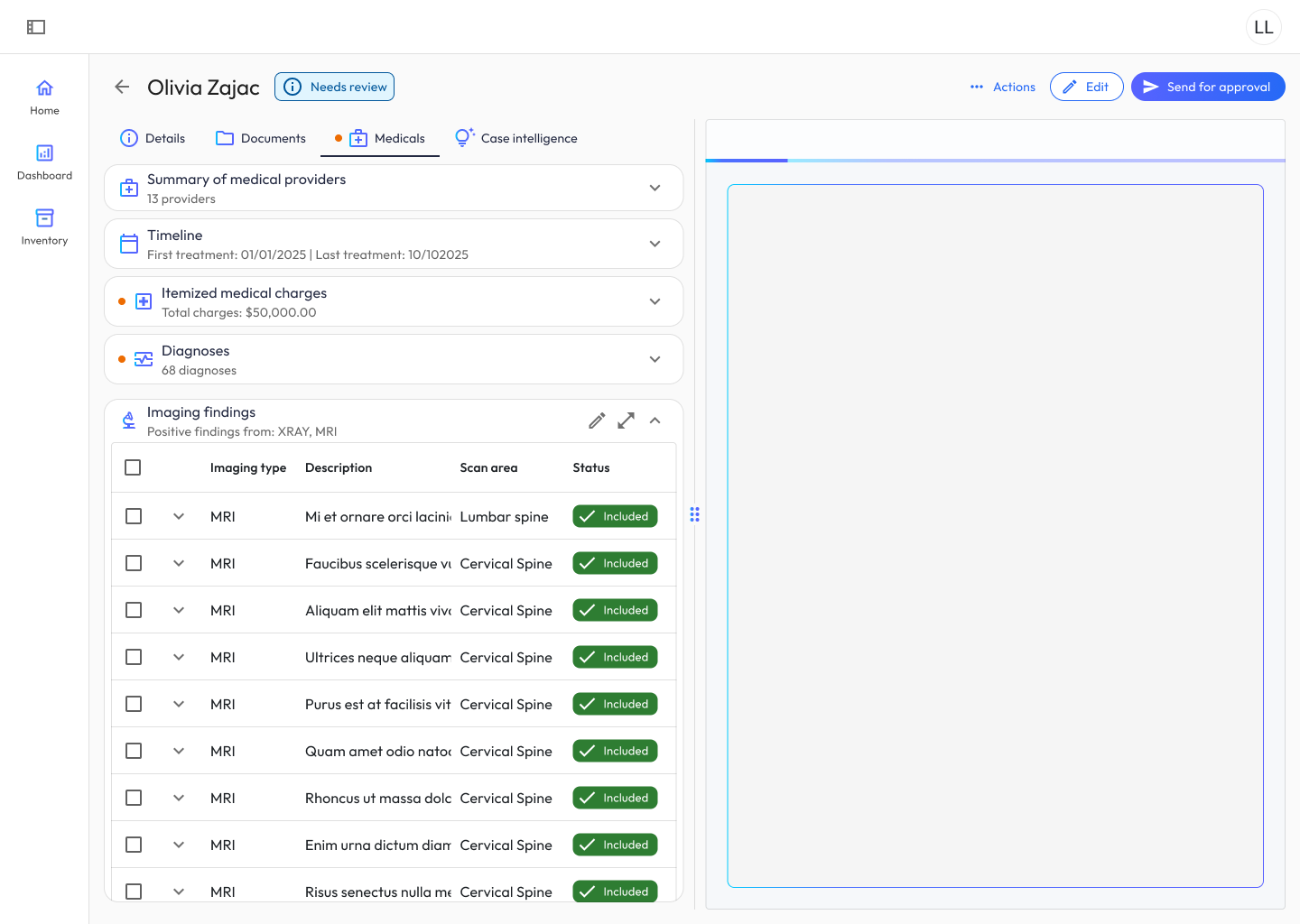
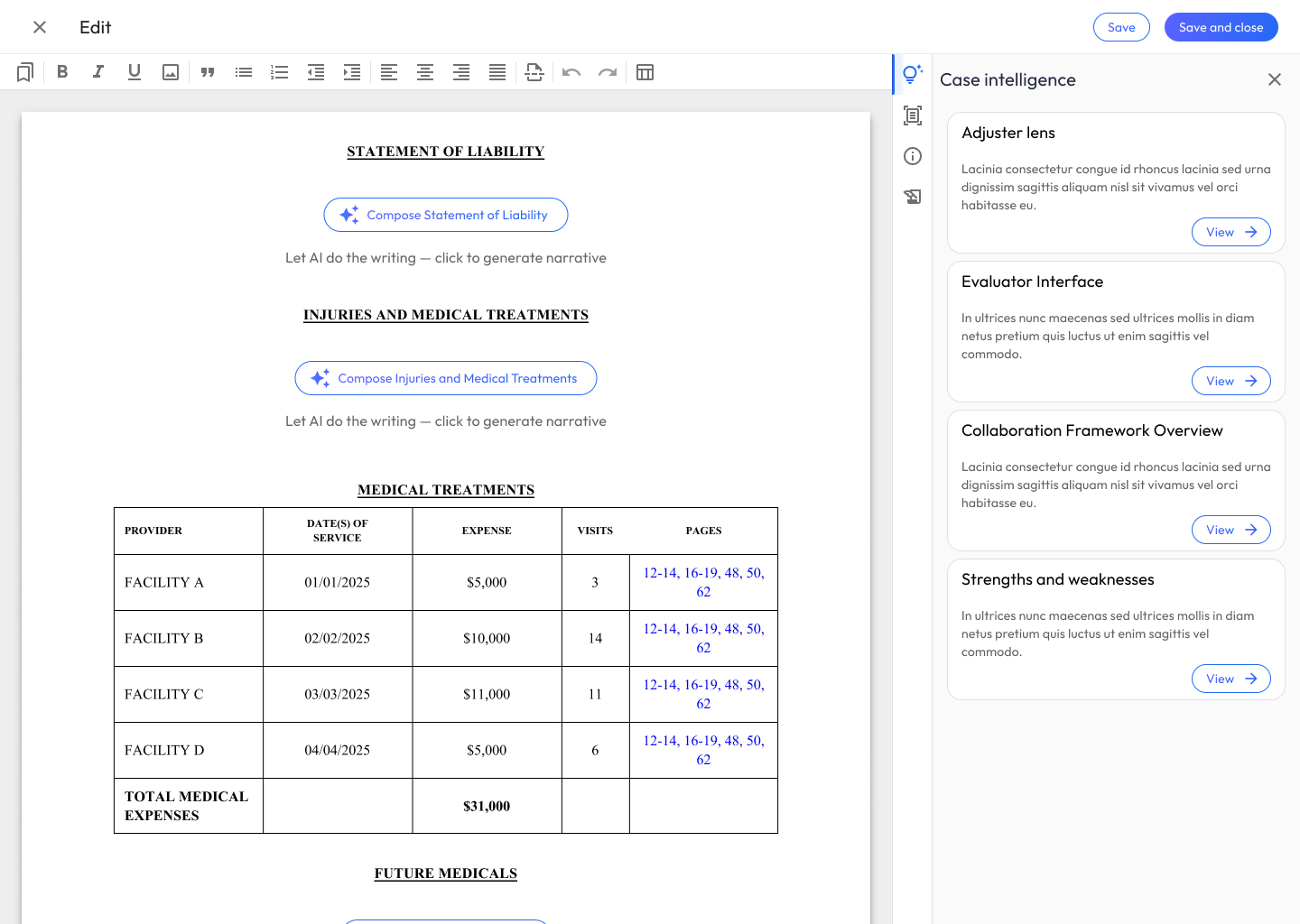
Attorneys or paralegals upload medical records, bills, and supporting documentation. The system ingests, parses, and extracts structured data — treatment dates, providers, diagnoses, procedures, imaging findings, and billing information

Step 2: Flagged Treatment Review

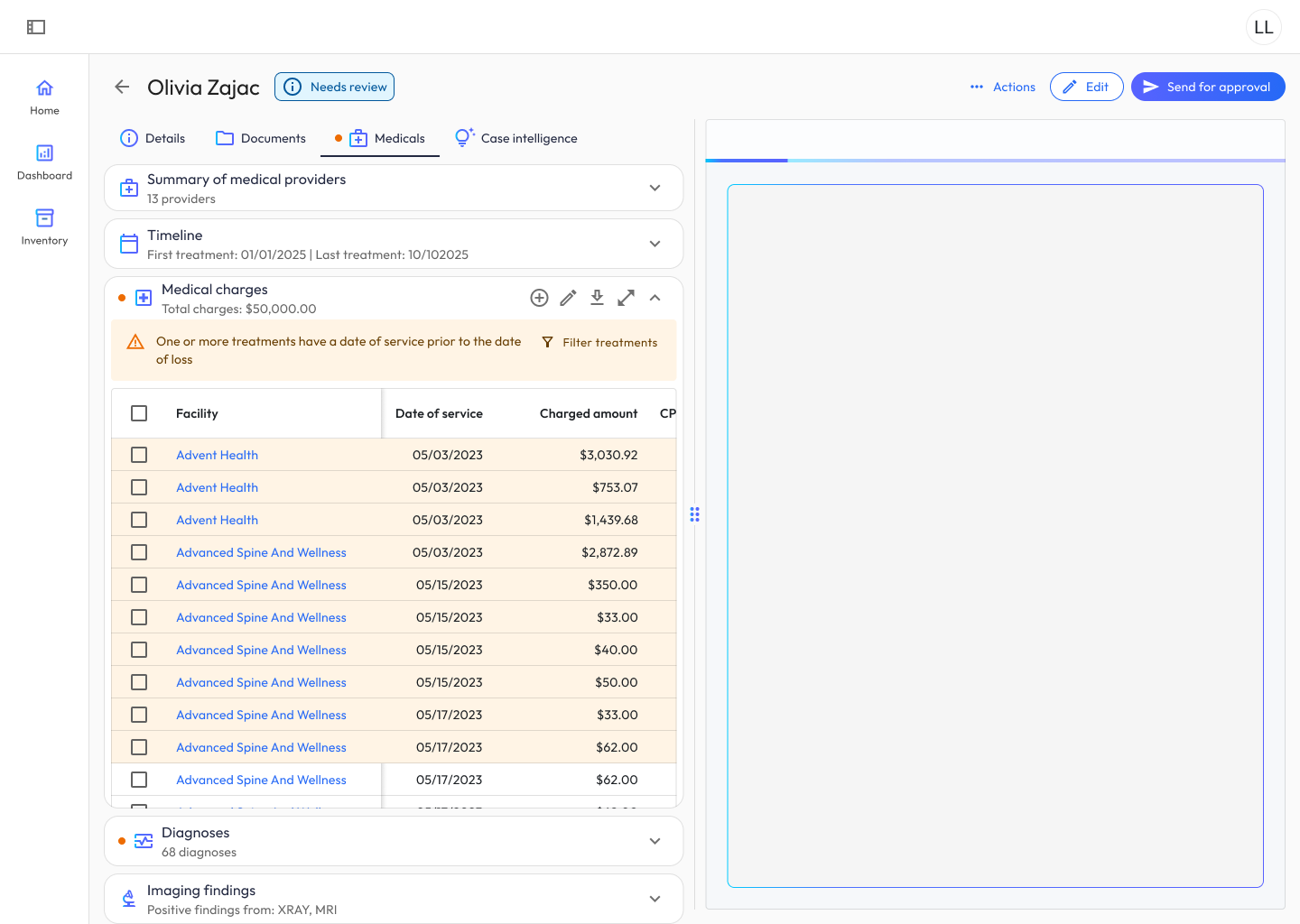
This is where the human-in-the-loop model earns its value. The system automatically flags treatments that need attorney review:

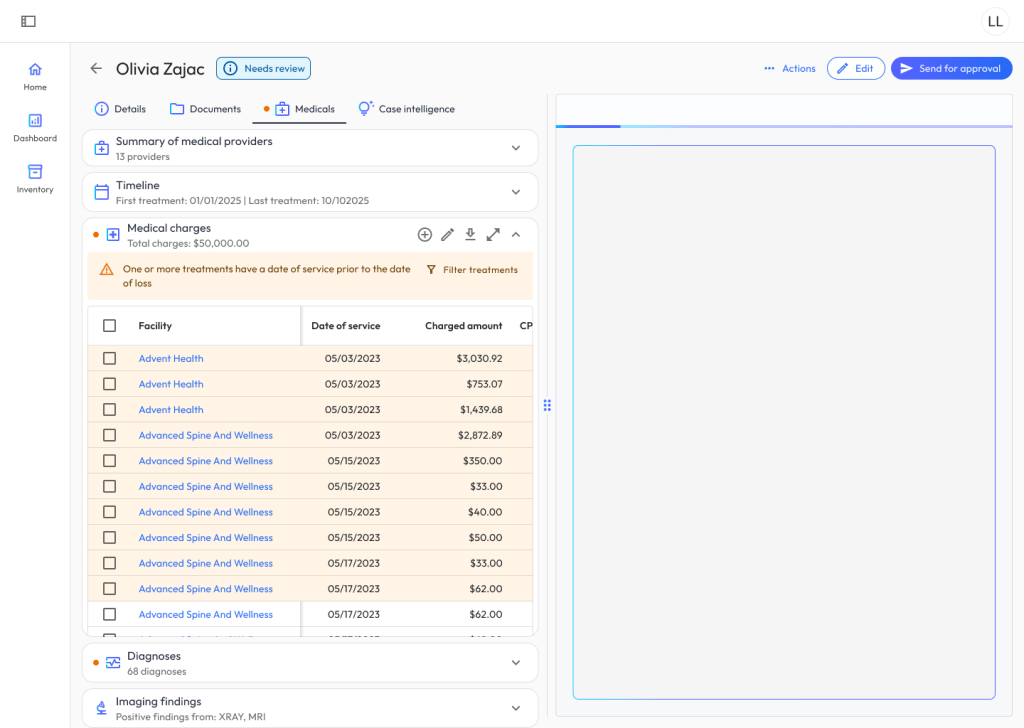
  • Pre-existing conditions — treatments that predate the date of loss
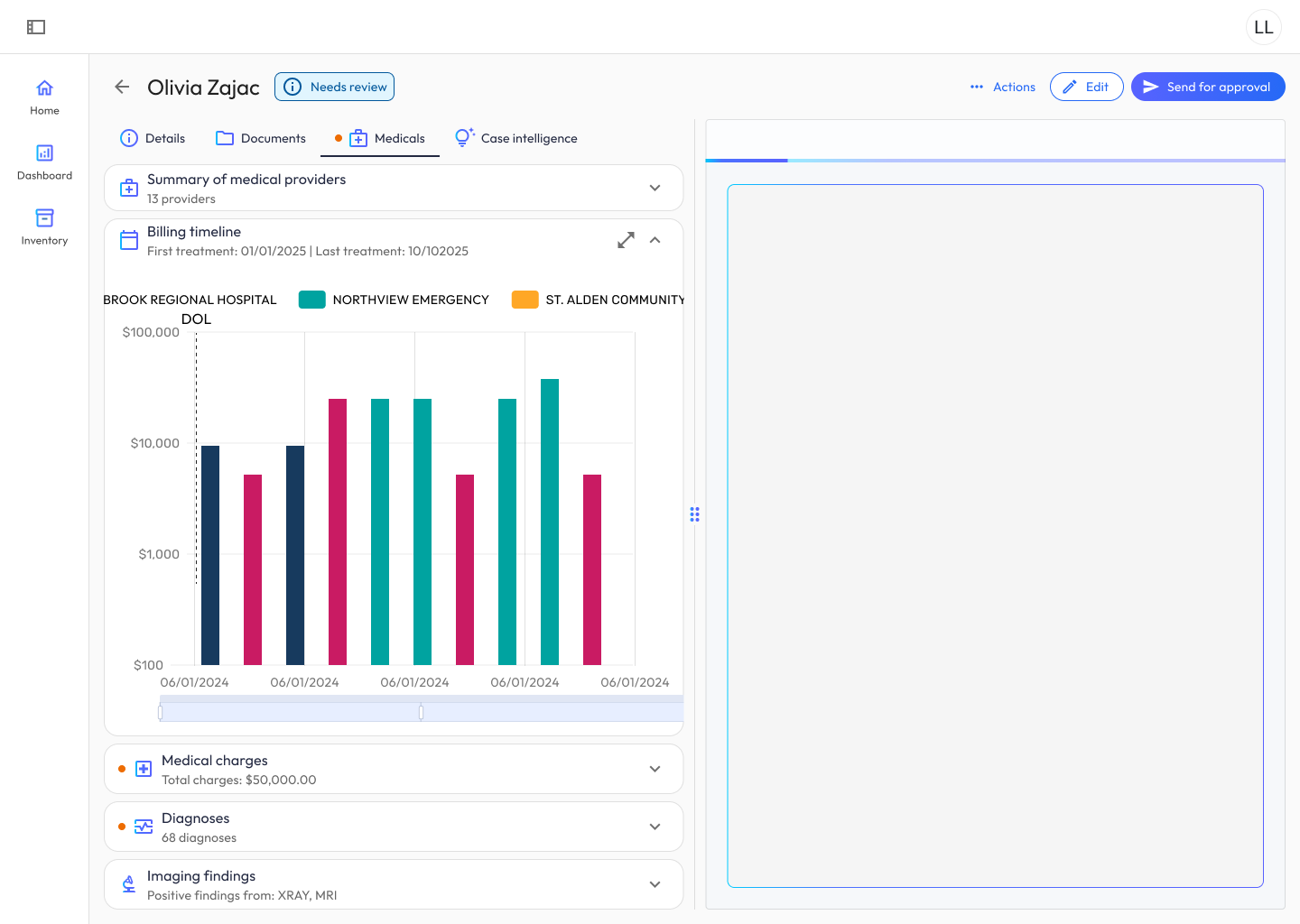
  • Temporal anomalies — gaps or overlaps in treatment timelines
  • Billing discrepancies — missing bills, duplicate charges, or inconsistent amounts
  • Causation questions — treatments that may not be clearly linked to the incident

I designed the review interface around rapid decision-making. Attorneys see a filterable, sortable tables of flagged items with contextual detail, enough information to make a judgment call without switching to the source document.

Design decisions that mattered here:

  • Inline context over modal detail views. Early iterations used modals to show flag details, but user testing revealed that attorneys lose their place in the review queue. I redesigned to use expandable rows with contextual information visible in-flow.
  • Batch actions for common patterns. Attorneys often resolve multiple flags of the same type (e.g., dismissing all pre-DOL treatments for a specific provider). I added batch selection and resolution to reduce repetitive clicks.
  • Filter persistence. Review sessions can span multiple sittings. Filters and scroll position persist across sessions so attorneys can pick up where they left off.

Step 3: Narrative Generation

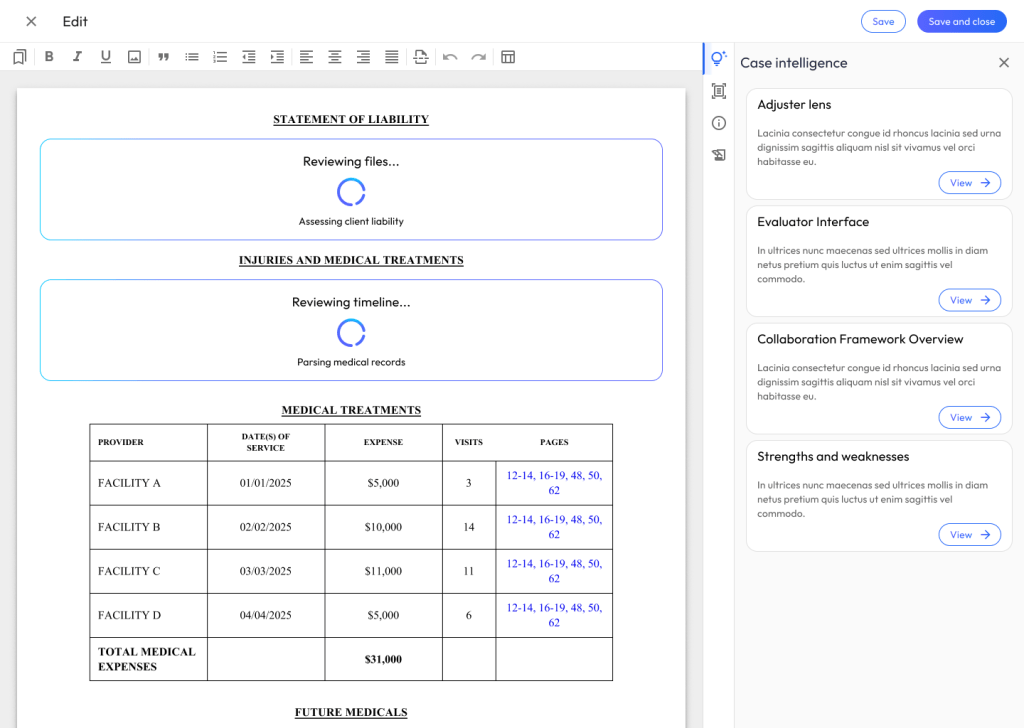
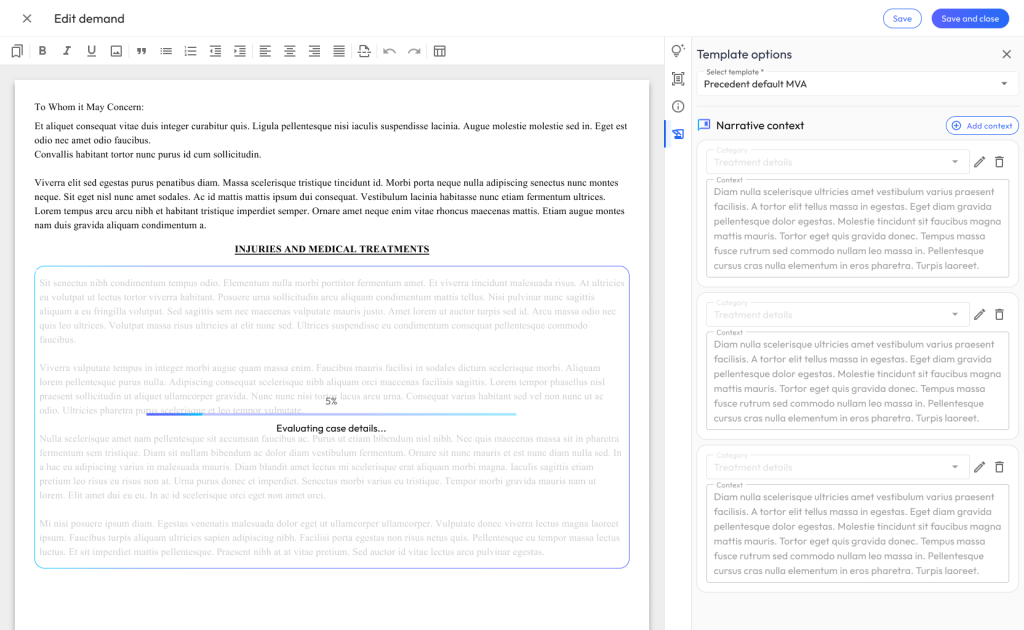
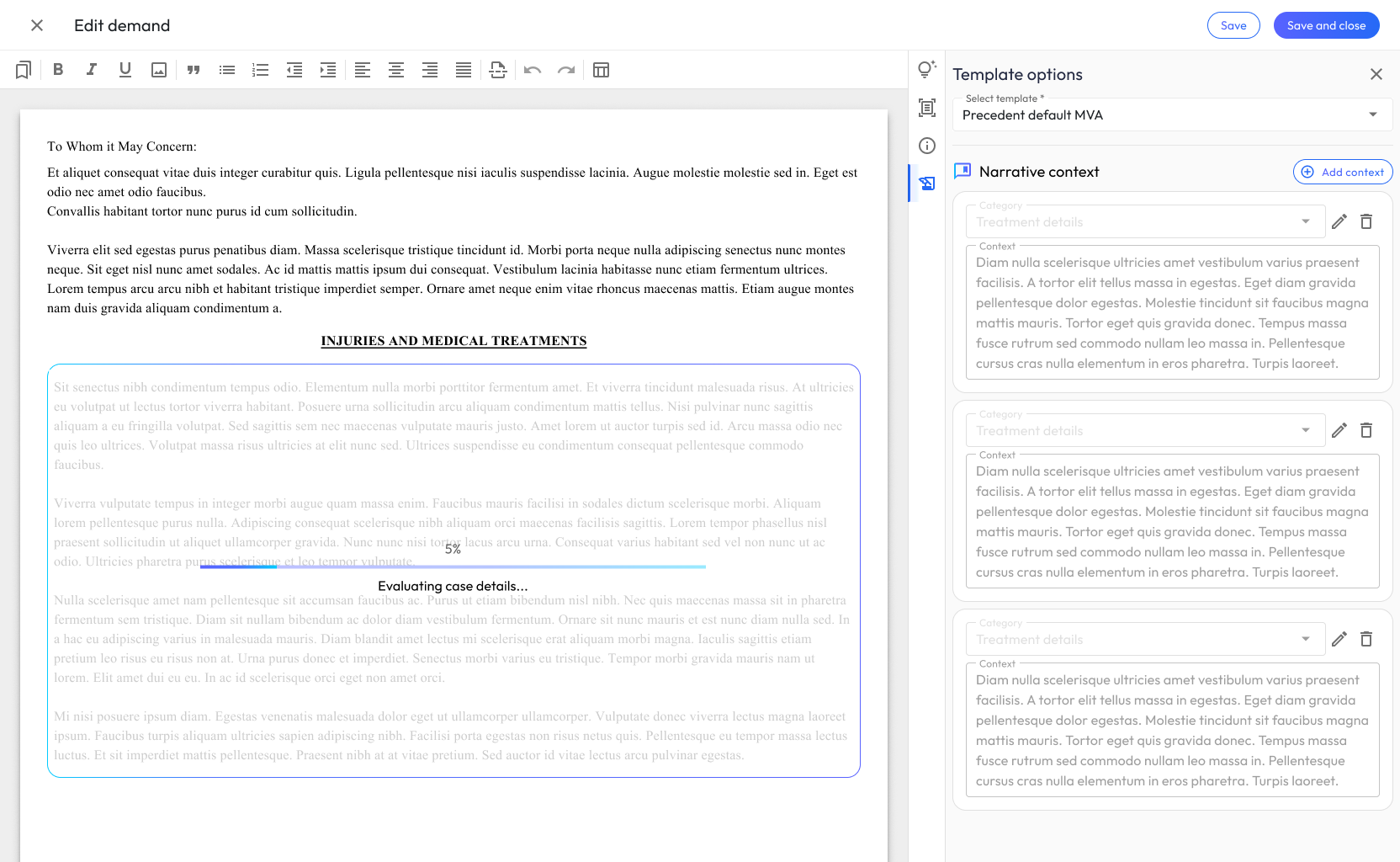
Using RAG against the processed medical records and resolved treatment data, the system generates narrative sections for the demand letter:

  • Injury narrative — a synthesized account of the client’s injuries and treatment course
  • Pain and suffering — a description of the impact on daily life, informed by treatment patterns and diagnoses
  • Loss of income — a financial impact narrative tied to documented treatment dates and work restrictions
  • Imaging findings — summaries of diagnostic imaging (X-rays, MRIs, CT scans) and their clinical significance

Step 4: Narrative Review & Refinement

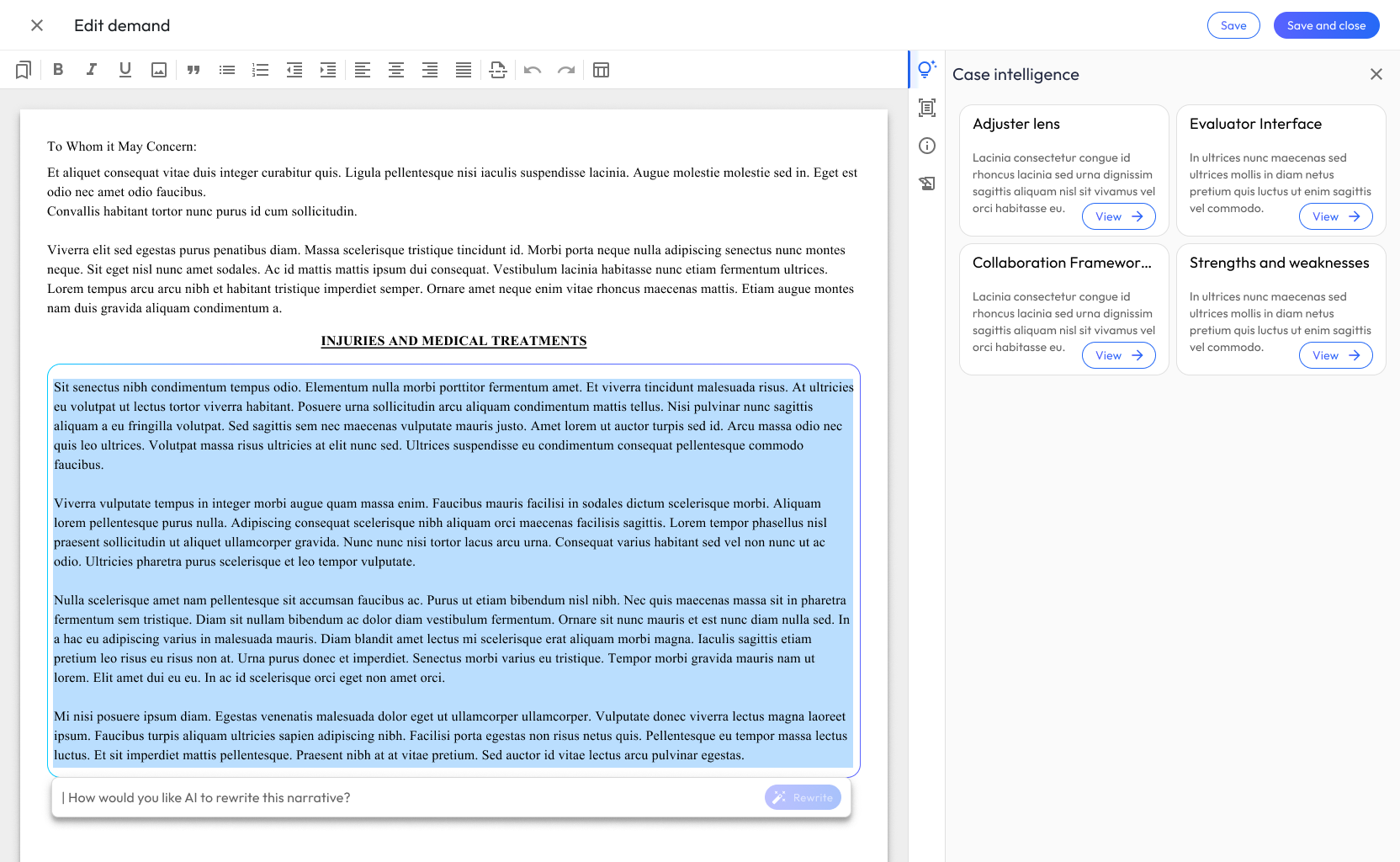
This is the most interaction-rich part of the workflow, and where the most design iteration happened. Attorneys need to review AI-generated prose with the same critical eye they’d apply to a junior associate’s draft.

I designed the review experience around three modes of interaction:

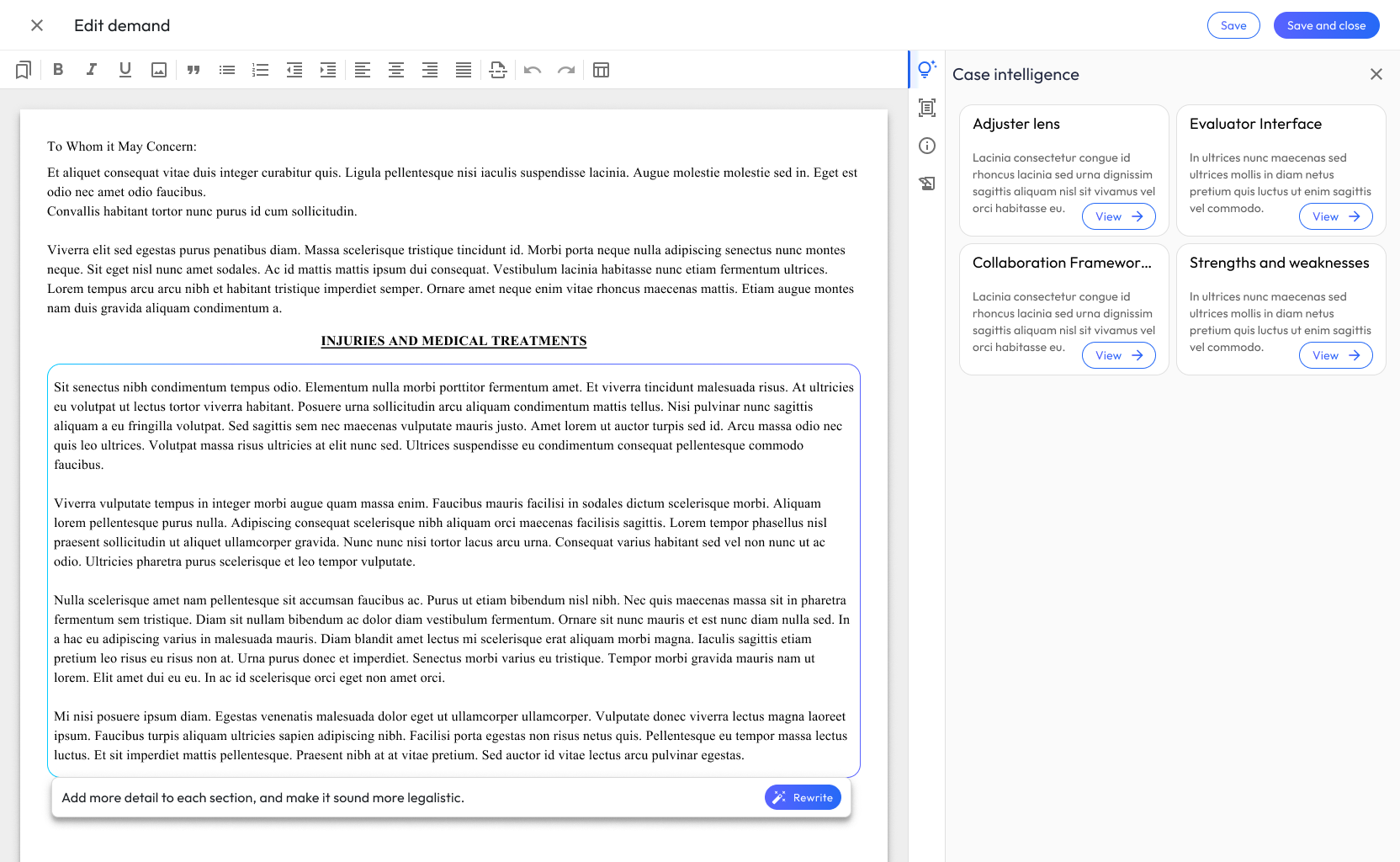
Read and accept. For narratives that are accurate and well-written, a simple approval flow. No friction added where none is needed.

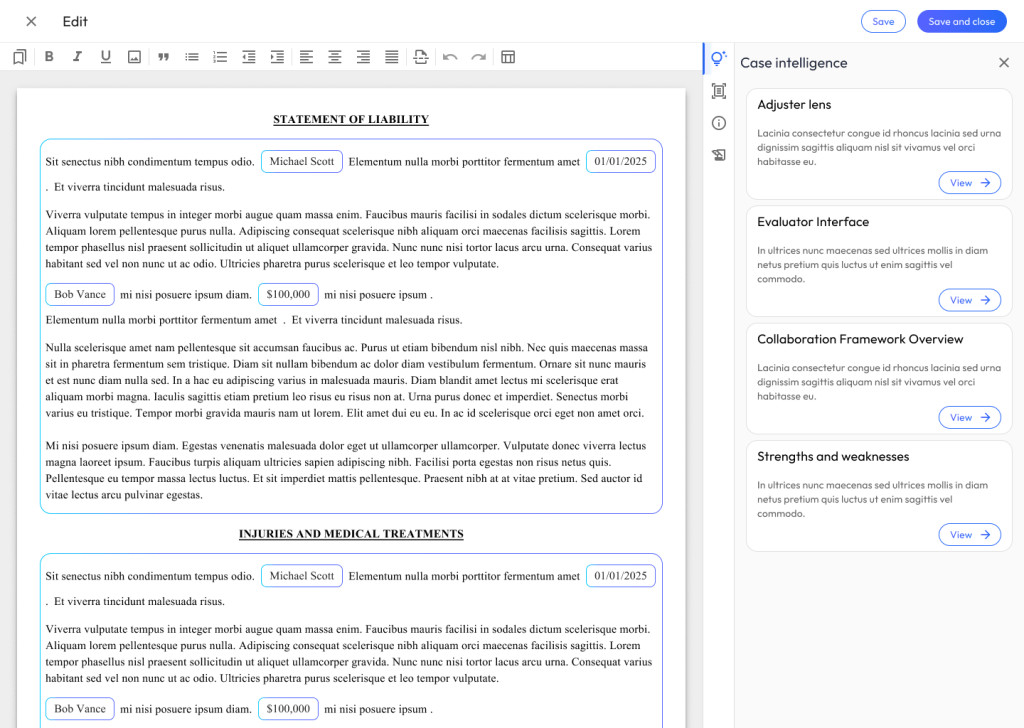
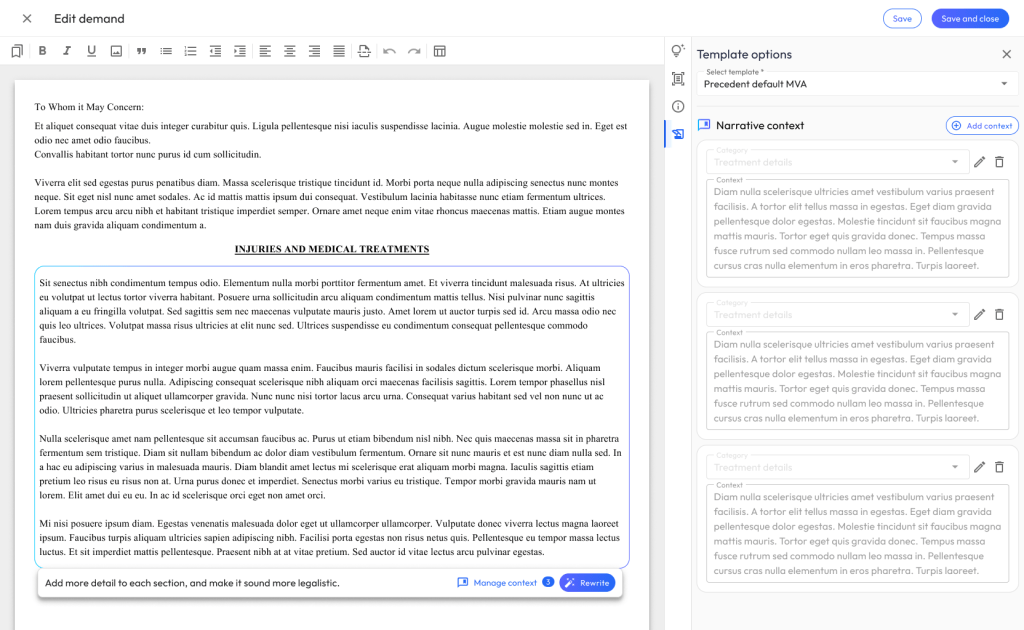
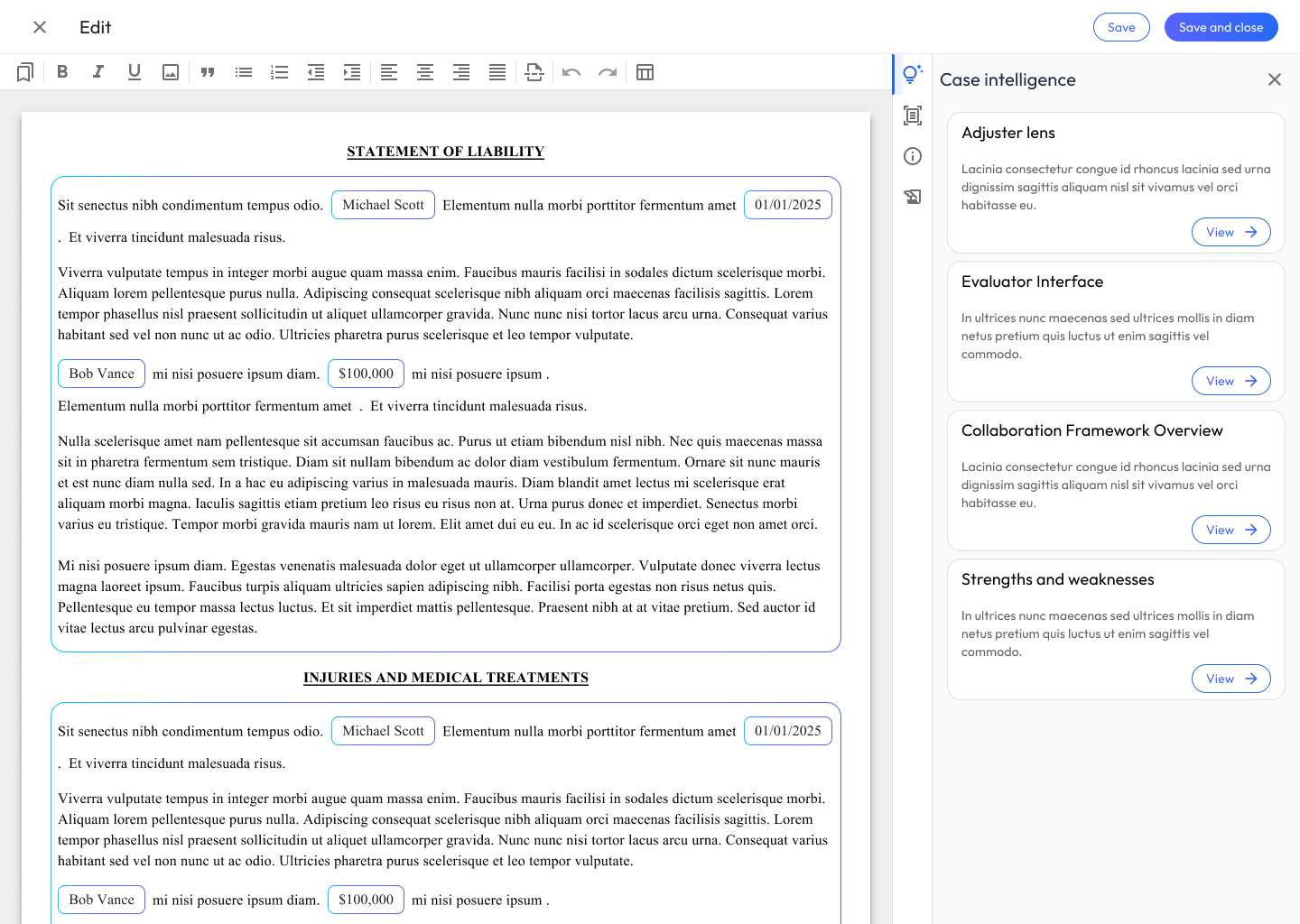
Direct edit. For targeted changes — a word choice, a factual correction, a tone adjustment — attorneys can edit the narrative text directly in a rich text editor.

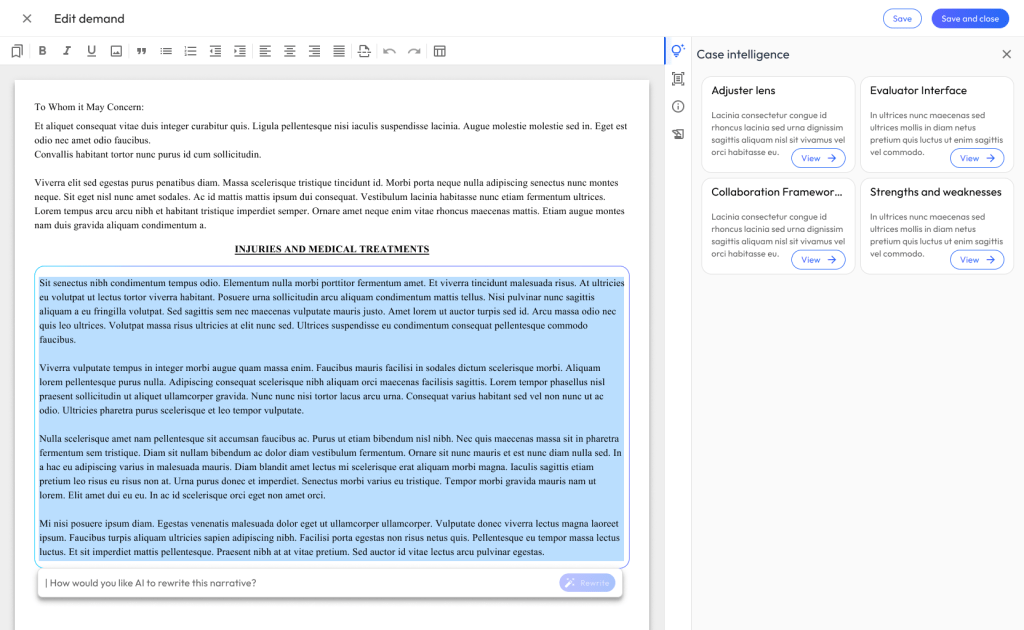
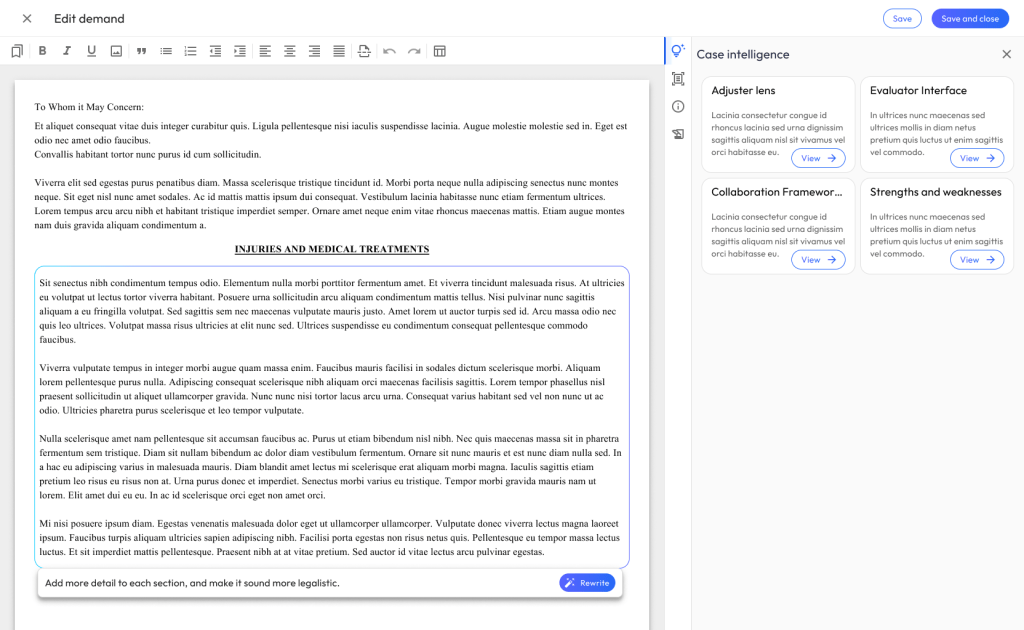
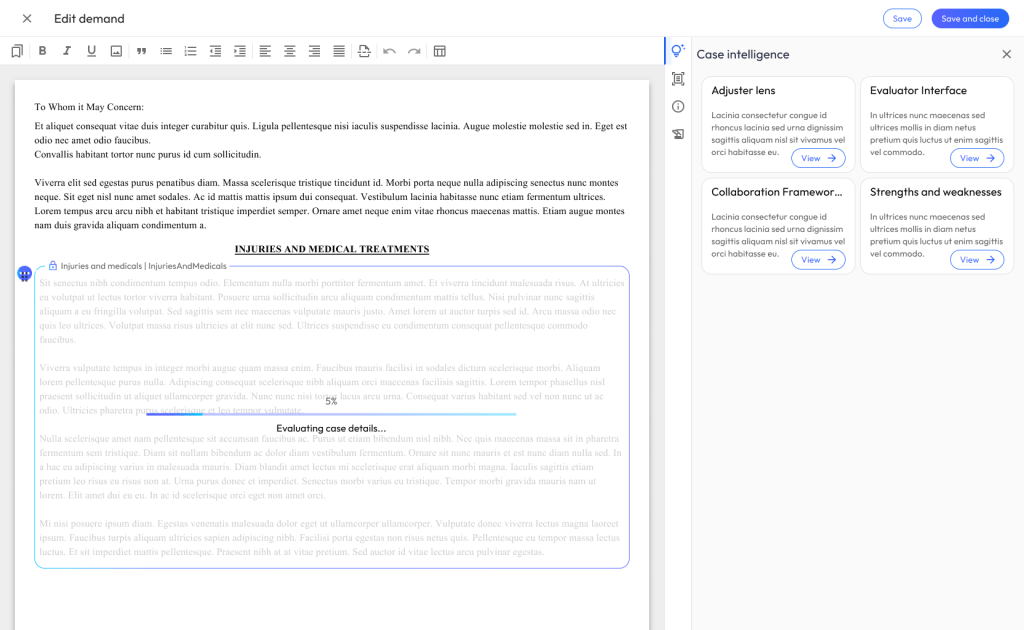
Instruct and regenerate. For narratives that need more substantial rework, attorneys can provide natural language instructions (e.g., “Emphasize the chronic nature of the lumbar injury” or “Remove references to the ER visit on 3/15”) and the system regenerates the section accordingly

Design decisions that mattered here:

  • Section-level granularity. Early designs generated the full demand letter as a single block. I advocated for section-level generation and review, which gives attorneys fine-grained control and makes regeneration fast and low-risk.
  • Side-by-side source view. During review, attorneys can pull up the source medical records alongside the generated narrative to verify claims against evidence.

Step 5: Narrative Context Management

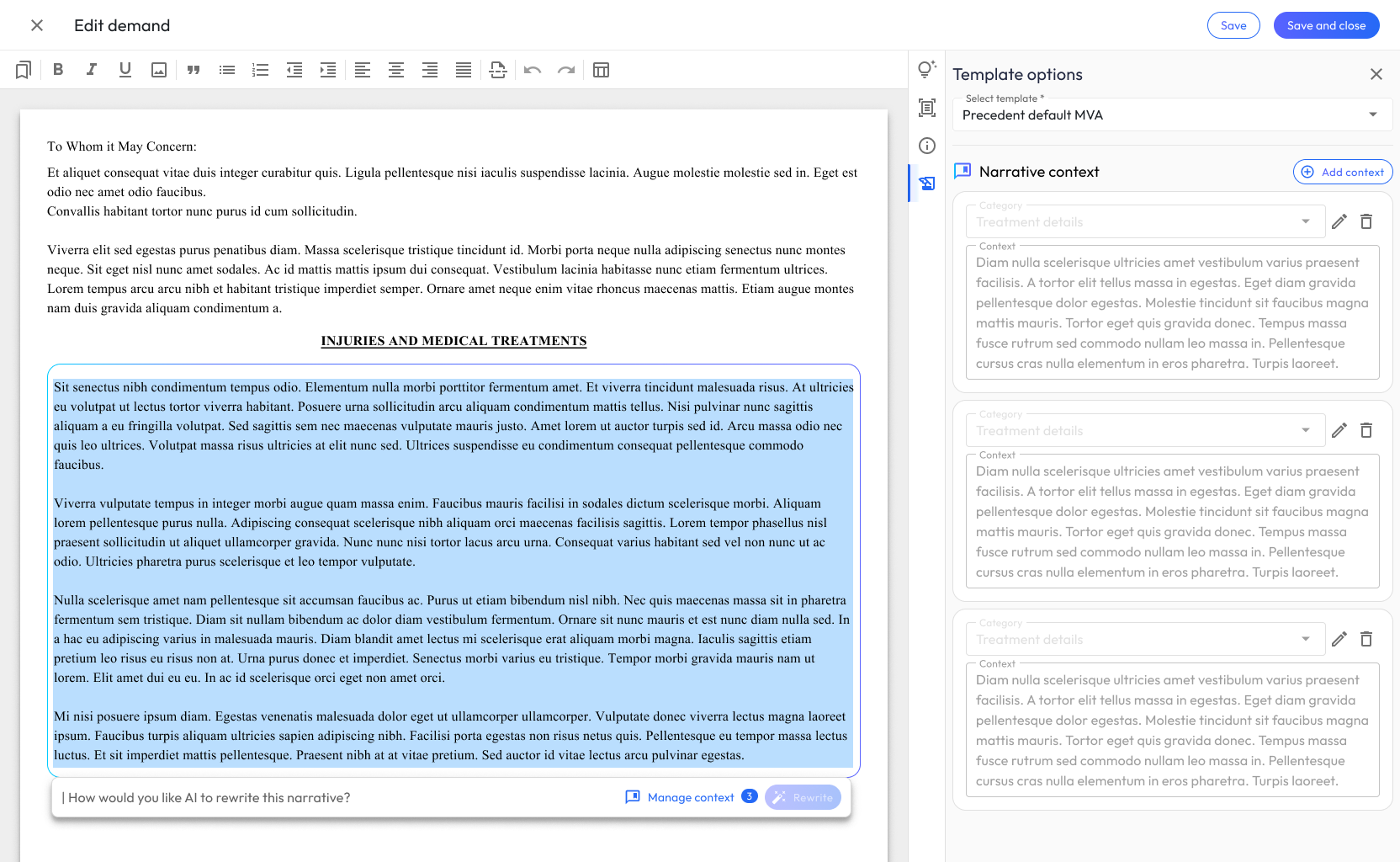
For complex cases, attorneys may need to adjust the context the AI uses for generation — adding case-specific details, excluding certain records, or emphasizing particular aspects of the injury.

I designed a context management interface that gives attorneys control over the RAG pipeline’s inputs without requiring them to understand the underlying technology. They work with familiar legal concepts (providers, date ranges, document types) rather than technical abstractions.

Outcomes

Business Impact

  • Dramatically reduced turnaround time for demand letter production,  from weeks of manual work to days with AI-assisted workflows
  • Improved accuracy in treatment extraction and billing reconciliation through systematic AI flagging and structured human review
  • Increased case throughput for law firms, allowing them to serve more clients without proportionally increasing headcount

User Impact

  • Attorneys spend their time on judgment calls, evaluating evidence, shaping narrative strategy, and making legal arguments, rather than on data entry and document assembly
  • Paralegals are freed from the most tedious extraction work, able to focus on case management and client communication
  • Clients benefit from faster resolutions and more thorough, accurate demand letters

Design Impact

  • Established a human-in-the-loop interaction model that became the foundation for subsequent Precedent products
  • Proved that AI-assisted legal workflows can maintain the professional rigor attorneys require while delivering meaningful efficiency gains
  • Demonstrated that the key to AI adoption in high-stakes domains isn’t more automation, it’s better-designed decision points